FTL AI School Summer Camp 2026
FTL AI School Summer Camps are designed for students ages 14-17 and up (12+ on case by case basis) who are ready to learn real-world money, business, investing, career, and ownership skills before adulthood sneaks up with long to do list. It is mainly built around highschoolers, but middle school children that are passionate about business and finance are welcome to join as well.
Our 10-week summer program introduces students to career options, real estate, business ownership, LLC setup, financial statements, compliance, and stock investing. Each class is designed to teach students how the real world works, how people earn money, buy homes, invest, build businesses, evaluate opportunities, and make smarter decisions about their future.
Monday through Thursday
(1 hour and 30 minutes per day)
Student cohorts:
1:00 PM – 2:30 PM
3:00 PM – 4:30 PM
Adult class:
5:00 PM – 6:30 PM
Tuition children: $125 per child per week
Tuition adults: $275 per adult per week
Register for 8 weeks and receive 10% off your classes
Register for 4 weeks and get free registration
Students will not just memorize terms. They will work through examples, compare options, review real-world scenarios, and complete hands-on activities that connect money, ownership, career planning, and business decision-making.
Registration fee: $35 one-time payment for onboarding documents
FTL AI School Summer Camp 2026
FTL AI School Summer Camps are designed for students ages 14-17 and up (12+ on case by case basis) who are ready to learn real-world money, business, investing, career, and ownership skills before adulthood sneaks up with long to do list. It is mainly built around highschoolers, but middle school children that are passionate about business and finance are welcome to join as well.
Our 10-week summer program introduces students to career options, real estate, business ownership, LLC setup, financial statements, compliance, and stock investing. Each class is designed to teach students how the real world works, how people earn money, buy homes, invest, build businesses, evaluate opportunities, and make smarter decisions about their future.
Monday through Thursday
(1 hour and 30 minutes per day)
Student cohorts:
1:00 PM – 2:30 PM
3:00 PM – 4:30 PM
Adult class:
5:00 PM – 6:30 PM
Tuition children: $125 per child per week
Tuition adults: $275 per adult per week
Register for 8 weeks and receive 10% off your classes
Register for 4 weeks and get free registration
Students will not just memorize terms. They will work through examples, compare options, review real-world scenarios, and complete hands-on activities that connect money, ownership, career planning, and business decision-making.
Registration fee: $35 one-time payment for onboarding documents
10-Week Summer Camp Calendar
Week 1 (June 1–4)
Career Class — Trades
(Career exploration and post-high-school paths)
Week 2 (June 8–11)
Real Estate Purchasing as a Primary Residence
(Buying your first home)
Week 3 (June 15–18)
Real Estate Purchases as Investments
(Rentals, cash flow, BRRRR basics)
Week 4 (June 22–25)
LLC Setup & Business Foundations
(How to start and structure a business)
Week 5 (June 29–July 2)
Business Finances & Compliance
(Understanding financial statements and reporting)
Week 6 (July 6–9)
Stock Investing & Evaluation — Part 1
(Market basics, companies, risk, accounts)
Week 7 (July 13–16)
Stock Investing & Evaluation — Part 2
(Valuation, financial statements, portfolio project)
Week 8 (July 20–23)
Career Class — Corporate
(Career exploration and post-high-school paths)
Week 9 (July 27–30)
AI Tools & Future Skills
(AI tools and how to use them to make life and business easier)
Week 10 (August 3–6)
Real Estate Purchases as Investments
(Rentals, cash flow, BRRRR basics)
Weekly Class Structure
Each 4-day camp follows the same framework:
Day
Monday
Tuesday
Wednesday
Thursday
Focus
Core concept + real-world examples
Numbers, vocabulary, and decision-making tools
Practice with a real-world example or project
Build, present, or complete a final class activity
10-Week Summer Camp Calendar
Week 1 (June 1–4)
Career Class — Trades
(Career exploration and post-high-school paths)
Week 2 (June 8–11)
Real Estate Purchasing as a Primary Residence
(Buying your first home)
Week 3 (June 15–18)
Real Estate Purchases as Investments
(Rentals, cash flow, BRRRR basics)
Week 4 (June 22–25)
LLC Setup & Business Foundations
(How to start and structure a business)
Week 5 (June 29–July 2)
Business Finances & Compliance
(Understanding financial statements and reporting)
Week 6 (July 6–9)
Stock Investing & Evaluation — Part 1
(Market basics, companies, risk, accounts)
Week 7 (July 13–16)
Stock Investing & Evaluation — Part 2
(Valuation, financial statements, portfolio project)
Week 8 (July 20–23)
Career Class — Corporate
(Career exploration and post-high-school paths)
Week 9 (July 27–30)
AI Tools & Future Skills
(AI tools and how to use them to make life and business easier)
Week 10 (August 3–6)
Real Estate Purchases as Investments
(Rentals, cash flow, BRRRR basics)
Weekly Class Structure
Each 4-day camp follows the same framework:
Day
Monday - Core concept + real-world examples
Tuesday - Numbers, vocabulary, and decision-making tools
Wednesday - Practice with a real-world example or project
Thursday - Build, present, or complete a final class activity
Week 1: Career Class — Trades
Career Class: Trades & Skilled Careers

This camp introduces students to career opportunities in the skilled trades and hands-on industries. Students will explore careers that do not always require a traditional four-year college degree but can lead to strong income, business ownership, and long-term stability.
Students will learn about careers in construction, electrical work, plumbing, HVAC, welding, mechanics, industrial work, equipment operation, cosmetology, healthcare support roles, and other skilled professions. They will compare training requirements, apprenticeships, certifications, income potential, startup costs, work environments, and opportunities to eventually become self-employed.
This class helps students understand that success after high school can come from many paths — college, trade school, apprenticeships, military service, entrepreneurship, or going directly into the workforce with a plan.
What Students Will Learn
Area
Covered Topics
Trade Career Options
Construction, HVAC, welding, electrical, plumbing, mechanics, equipment operation, cosmetology, healthcare support
Education Paths
Trade school, apprenticeships, certifications, licensing, on-the-job training
Income Potential
Hourly pay, overtime, self-employment, business ownership
Career Costs
Training cost, tools, certifications, transportation
Lifestyle
Physical work, schedules, job sites, travel, safety
Business Ownership
How trades can lead to starting a company
Local Opportunity
Jobs and business needs in Louisiana and surrounding markets
Student Project
Students will choose one trade career and create a simple career roadmap showing training requirements, expected income, tools or certifications needed, and long-term business ownership potential.
Week 1: Career Class — Trades
Career Class: Trades & Skilled Careers
This camp introduces students to career opportunities in the skilled trades and hands-on industries. Students will explore careers that do not always require a traditional four-year college degree but can lead to strong income, business ownership, and long-term stability.
Students will learn about careers in construction, electrical work, plumbing, HVAC, welding, mechanics, industrial work, equipment operation, cosmetology, healthcare support roles, and other skilled professions. They will compare training requirements, apprenticeships, certifications, income potential, startup costs, work environments, and opportunities to eventually become self-employed.
This class helps students understand that success after high school can come from many paths — college, trade school, apprenticeships, military service, entrepreneurship, or going directly into the workforce with a plan.
What Students Will Learn
Area
Covered Topics
Trade Career Options
Construction, HVAC, welding, electrical, plumbing, mechanics, equipment operation, cosmetology, healthcare support
Education Paths
Trade school, apprenticeships, certifications, licensing, on-the-job training
Income Potential
Hourly pay, overtime, self-employment, business ownership
Career Costs
Training cost, tools, certifications, transportation
Lifestyle
Physical work, schedules, job sites, travel, safety
Business Ownership
How trades can lead to starting a company
Local Opportunity
Jobs and business needs in Louisiana and surrounding markets
Student Project
Students will choose one trade career and create a simple career roadmap showing training requirements, expected income, tools or certifications needed, and long-term business ownership potential.
Week 2: Real Estate Purchasing as a Primary Residence
Buying Your First Home: Real Estate as a Primary Residence

In this camp, students will learn what it means to buy a home as a primary residence. They will explore the step-by-step process of purchasing a house, from saving for a down payment to understanding credit, mortgages, inspections, insurance, taxes, closing costs, and monthly payments.
Students will learn how banks look at buyers, what makes a home affordable, and why buying a home is one of the biggest financial decisions most families make. They will also compare renting versus buying and learn how location, condition, interest rates, and household income affect the decision.
By the end of the week, students will understand the basic home-buying process and complete a simple “Can I afford this house?” activity using real-world numbers.
What Students Will Learn
Area
Covered Topics
Home Buying Basics
Primary residence, buyer, seller, lender, title company, closing
Money Requirements
Down payment, closing costs, monthly payment, escrow
Mortgage Basics
Principal, interest, taxes, insurance, loan terms
Credit & Income
Credit scores, debt-to-income ratio, income verification
Property Review
Inspections, repairs, appraisal, insurance
Smart Decision-Making
Renting vs buying, affordability, location, long-term costs
Student Project
Students will review a sample home listing and determine whether a buyer could afford it based on income, down payment, loan terms, taxes, insurance, and monthly debt.
Week 2: Real Estate Purchasing as a Primary Residence
Buying Your First Home: Real Estate as a Primary Residence
In this camp, students will learn what it means to buy a home as a primary residence. They will explore the step-by-step process of purchasing a house, from saving for a down payment to understanding credit, mortgages, inspections, insurance, taxes, closing costs, and monthly payments.
Students will learn how banks look at buyers, what makes a home affordable, and why buying a home is one of the biggest financial decisions most families make. They will also compare renting versus buying and learn how location, condition, interest rates, and household income affect the decision.
By the end of the week, students will understand the basic home-buying process and complete a simple “Can I afford this house?” activity using real-world numbers.
What Students Will Learn
Area
Covered Topics
Home Buying Basics
Primary residence, buyer, seller, lender, title company, closing
Money Requirements
Down payment, closing costs, monthly payment, escrow
Mortgage Basics
Principal, interest, taxes, insurance, loan terms
Credit & Income
Credit scores, debt-to-income ratio, income verification
Property Review
Inspections, repairs, appraisal, insurance
Smart Decision-Making
Renting vs buying, affordability, location, long-term costs
Student Project
Students will review a sample home listing and determine whether a buyer could afford it based on income, down payment, loan terms, taxes, insurance, and monthly debt.
Week 3: Real Estate Purchases as Investments
Real Estate Investing: How Rental Properties Make Money

This camp introduces students to real estate as an investment. Students will learn how investors evaluate rental properties, estimate income and expenses, calculate cash flow, and understand the difference between owning a home to live in and owning property to generate income.
Students will explore rental income, repairs, vacancies, property management, insurance, taxes, financing, appreciation, equity, and long-term wealth building. They will also learn basic investment strategies such as buy-and-hold rentals, fix-and-flip properties, duplexes, small multifamily properties, and the BRRRR method.
By the end of the week, students will evaluate a sample rental property and decide whether it is a good investment.
What Students Will Learn
Area
Covered Topics
Investment Property Basics
Rental property, tenant, landlord, lease, property manager
Income
Rent, deposits, late fees, laundry, storage, other income
Expenses
Mortgage, taxes, insurance, repairs, vacancy, utilities
Cash Flow
Monthly rent minus monthly expenses
Equity & Appreciation
How property value and loan payoff build wealth
Risk
Bad tenants, repairs, vacancies, market changes
Strategy
Buy-and-hold, flip, BRRRR, duplexes, small apartments
Student Project
Students will analyze a sample rental property and calculate estimated rent, expenses, cash flow, and return potential.
Week 3: Real Estate Purchases as Investments
Real Estate Investing: How Rental Properties Make Money
This camp introduces students to real estate as an investment. Students will learn how investors evaluate rental properties, estimate income and expenses, calculate cash flow, and understand the difference between owning a home to live in and owning property to generate income.
Students will explore rental income, repairs, vacancies, property management, insurance, taxes, financing, appreciation, equity, and long-term wealth building. They will also learn basic investment strategies such as buy-and-hold rentals, fix-and-flip properties, duplexes, small multifamily properties, and the BRRRR method.
By the end of the week, students will evaluate a sample rental property and decide whether it is a good investment.
What Students Will Learn
Area
Covered Topics
Investment Property Basics
Rental property, tenant, landlord, lease, property manager
Income
Rent, deposits, late fees, laundry, storage, other income
Expenses
Mortgage, taxes, insurance, repairs, vacancy, utilities
Cash Flow
Monthly rent minus monthly expenses
Equity & Appreciation
How property value and loan payoff build wealth
Risk
Bad tenants, repairs, vacancies, market changes
Strategy
Buy-and-hold, flip, BRRRR, duplexes, small apartments
Student Project
Students will analyze a sample rental property and calculate estimated rent, expenses, cash flow, and return potential.
Week 4: LLC Setup & Business Foundations
LLC Setup: How Businesses Are Legally Built

This camp teaches students the basic structure behind starting a business. Students will learn what an LLC is, why business owners use legal entities, and how businesses protect themselves, organize money, and operate professionally.
Students will explore business names, registered agents, ownership, operating agreements, EINs, bank accounts, licenses, insurance, bookkeeping, and the difference between personal and business money. The goal is not to turn students into lawyers or accountants, but to help them understand that real businesses need structure — not just a logo and a dream.
By the end of the week, students will design a sample LLC structure for a business idea.
What Students Will Learn
Area
Covered Topics
Business Entity Basics
Sole proprietorship, LLC, corporation
LLC Purpose
Liability protection, ownership structure, professionalism
Startup Steps
Name, state filing, registered agent, EIN, bank account
Operating Agreement
Owners, roles, voting, profits, responsibilities
Business Money
Separate bank account, bookkeeping, expenses
Compliance
Licenses, permits, taxes, insurance
Professional Habits
Contracts, invoices, recordkeeping
Student Project
Students will create a mock LLC setup plan, including business name, purpose, owner roles, startup checklist, and basic operating rules.
Week 4: LLC Setup & Business Foundations
LLC Setup: How Businesses Are Legally Built
This camp teaches students the basic structure behind starting a business. Students will learn what an LLC is, why business owners use legal entities, and how businesses protect themselves, organize money, and operate professionally.
Students will explore business names, registered agents, ownership, operating agreements, EINs, bank accounts, licenses, insurance, bookkeeping, and the difference between personal and business money. The goal is not to turn students into lawyers or accountants, but to help them understand that real businesses need structure — not just a logo and a dream.
By the end of the week, students will design a sample LLC structure for a business idea.
What Students Will Learn
Area
Covered Topics
Business Entity Basics
Sole proprietorship, LLC, corporation
LLC Purpose
Liability protection, ownership structure, professionalism
Startup Steps
Name, state filing, registered agent, EIN, bank account
Operating Agreement
Owners, roles, voting, profits, responsibilities
Business Money
Separate bank account, bookkeeping, expenses
Compliance
Licenses, permits, taxes, insurance
Professional Habits
Contracts, invoices, recordkeeping
Student Project
Students will create a mock LLC setup plan, including business name, purpose, owner roles, startup checklist, and basic operating rules.
Week 5: Business Finances & Compliance
Business Finances & Compliance: Understanding the Numbers Behind a Business

This camp teaches students how businesses track money, measure performance, and stay organized. Students will learn the basics of financial statements, business records, reporting, taxes, and compliance responsibilities.
Students will explore revenue, expenses, profit, loss, assets, liabilities, cash flow, invoices, receipts, bookkeeping, bank statements, and basic tax concepts. They will learn why successful business owners must understand their numbers and why poor recordkeeping can create serious problems.
This class gives students a practical introduction to how businesses stay financially healthy and legally organized.
What Students Will Learn
Area
Covered Topics
Business Money Basics
Revenue, expenses, profit, loss, cash flow
Financial Statements
Profit & loss statement, balance sheet, cash flow statement
Bookkeeping
Income tracking, expense tracking, receipts, categories
Banking
Business bank accounts, deposits, statements, reconciliation
Compliance
Reports, licenses, renewals, deadlines, records
Taxes
Sales tax basics, income tax basics, payroll tax overview
Business Decisions
Using numbers to price, budget, grow, or cut costs
Student Project
Students will review a mock business and create a simple profit and loss statement, identify whether the business is profitable, and recommend improvements.
Week 5: Business Finances & Compliance
Business Finances & Compliance: Understanding the Numbers Behind a Business
This camp teaches students how businesses track money, measure performance, and stay organized. Students will learn the basics of financial statements, business records, reporting, taxes, and compliance responsibilities.
Students will explore revenue, expenses, profit, loss, assets, liabilities, cash flow, invoices, receipts, bookkeeping, bank statements, and basic tax concepts. They will learn why successful business owners must understand their numbers and why poor recordkeeping can create serious problems.
This class gives students a practical introduction to how businesses stay financially healthy and legally organized.
What Students Will Learn
Area
Covered Topics
Business Money Basics
Revenue, expenses, profit, loss, cash flow
Financial Statements
Profit & loss statement, balance sheet, cash flow statement
Bookkeeping
Income tracking, expense tracking, receipts, categories
Banking
Business bank accounts, deposits, statements, reconciliation
Compliance
Reports, licenses, renewals, deadlines, records
Taxes
Sales tax basics, income tax basics, payroll tax overview
Business Decisions
Using numbers to price, budget, grow, or cut costs
Student Project
Students will review a mock business and create a simple profit and loss statement, identify whether the business is profitable, and recommend improvements.
Week 6: Stock Investing & Evaluation — Part 1
Stock Investing & Evaluation: Market Basics

This camp introduces students to the stock market and the basics of owning shares in public companies. Students will learn what stocks are, why companies sell shares, how investors make money, and why prices move up and down.
Students will explore stock exchanges, shares, dividends, investment accounts, market indexes, risk, diversification, and the difference between investing and gambling. This class helps students understand the stock market as a tool for long-term ownership rather than a guessing game.
What Students Will Learn
Area
Covered Topics
Stock Market Basics
Stocks, shares, public companies, exchanges
How Investors Make Money
Price growth, dividends, long-term ownership
Investment Accounts
Brokerage accounts, custodial accounts, retirement accounts
Market Indexes
S&P 500, Dow Jones, Nasdaq
Risk
Volatility, loss, speculation, emotional decisions
Diversification
Why investors do not put everything into one company
Investor Mindset
Patience, research, discipline
Student Project
Students will choose several public companies they recognize and research what each company sells, how it makes money, and why investors might buy or avoid the stock.
Week 6: Stock Investing & Evaluation — Part 1
Stock Investing & Evaluation: Market Basics
This camp introduces students to the stock market and the basics of owning shares in public companies. Students will learn what stocks are, why companies sell shares, how investors make money, and why prices move up and down.
Students will explore stock exchanges, shares, dividends, investment accounts, market indexes, risk, diversification, and the difference between investing and gambling. This class helps students understand the stock market as a tool for long-term ownership rather than a guessing game.
What Students Will Learn
Area
Covered Topics
Stock Market Basics
Stocks, shares, public companies, exchanges
How Investors Make Money
Price growth, dividends, long-term ownership
Investment Accounts
Brokerage accounts, custodial accounts, retirement accounts
Market Indexes
S&P 500, Dow Jones, Nasdaq
Risk
Volatility, loss, speculation, emotional decisions
Diversification
Why investors do not put everything into one company
Investor Mindset
Patience, research, discipline
Student Project
Students will choose several public companies they recognize and research what each company sells, how it makes money, and why investors might buy or avoid the stock.
Week 7: Stock Investing & Evaluation — Part 2
Stock Investing & Evaluation: Company Research & Portfolio Building

This second stock investing camp goes deeper into how investors evaluate companies before buying stock. Students will learn how to compare businesses, read basic financial information, understand revenue and profit, review debt, and think about whether a company has long-term growth potential.
Students will also learn basic valuation concepts, competitive advantage, dividends, company risk, and portfolio building. The goal is to help students think like long-term investors, not day traders chasing noise.
By the end of the week, students will create a mock investment portfolio and explain their choices.
What Students Will Learn
Area
Covered Topics
Company Research
What the company sells and who buys it
Financial Basics
Revenue, profit, expenses, debt
Valuation
Price, earnings, growth, comparison
Competitive Advantage
Brand, technology, network, cost advantage
Dividends
Income stocks versus growth stocks
Portfolio Building
Balancing risk and opportunity
Final Review
Explaining why an investment makes sense
Student Project
Students will create a mock stock portfolio, research selected companies, and explain whether they believe each company is a strong long-term investment.
Week 7: Stock Investing & Evaluation — Part 2
Stock Investing & Evaluation: Company Research & Portfolio Building
This second stock investing camp goes deeper into how investors evaluate companies before buying stock. Students will learn how to compare businesses, read basic financial information, understand revenue and profit, review debt, and think about whether a company has long-term growth potential.
Students will also learn basic valuation concepts, competitive advantage, dividends, company risk, and portfolio building. The goal is to help students think like long-term investors, not day traders chasing noise.
By the end of the week, students will create a mock investment portfolio and explain their choices.
What Students Will Learn
Area
Covered Topics
Company Research
What the company sells and who buys it
Financial Basics
Revenue, profit, expenses, debt
Valuation
Price, earnings, growth, comparison
Competitive Advantage
Brand, technology, network, cost advantage
Dividends
Income stocks versus growth stocks
Portfolio Building
Balancing risk and opportunity
Final Review
Explaining why an investment makes sense
Student Project
Students will create a mock stock portfolio, research selected companies, and explain whether they believe each company is a strong long-term investment.
Week 8: Career Class — Corporate
Career Class: Corporate, Professional & Office Careers

This camp introduces students to corporate, professional, and office-based career paths. Students will explore careers that may require college, certifications, specialized training, strong communication skills, or business experience.
Students will learn about careers in finance, accounting, law, healthcare administration, marketing, management, technology, engineering, real estate, insurance, banking, operations, human resources, sales, and entrepreneurship. They will compare education requirements, income potential, career ladders, work environments, leadership opportunities, and long-term growth.
This class helps students understand what corporate and professional careers actually look like beyond job titles. Students will learn how people move from entry-level roles into management, ownership, consulting, or specialized expert positions.
What Students Will Learn
Area
Covered Topics
Career Options
Finance, accounting, law, marketing, tech, management, banking, insurance, real estate
Education Paths
College, certifications, internships, licenses, professional training
Income Potential
Salary, bonuses, commissions, promotions, ownership
Career Ladder
Entry-level roles, management, leadership, specialization
Workplace Skills
Communication, organization, problem-solving, professionalism
Lifestyle
Office work, remote work, travel, stress, flexibility
Long-Term Growth
Promotions, entrepreneurship, consulting, investing
Student Project
Students will choose one corporate or professional career and build a career roadmap showing education requirements, starting role, income potential, advancement opportunities, and skills needed.
Week 8: Career Class — Corporate
Career Class: Corporate, Professional & Office Careers
This camp introduces students to corporate, professional, and office-based career paths. Students will explore careers that may require college, certifications, specialized training, strong communication skills, or business experience.
Students will learn about careers in finance, accounting, law, healthcare administration, marketing, management, technology, engineering, real estate, insurance, banking, operations, human resources, sales, and entrepreneurship. They will compare education requirements, income potential, career ladders, work environments, leadership opportunities, and long-term growth.
This class helps students understand what corporate and professional careers actually look like beyond job titles. Students will learn how people move from entry-level roles into management, ownership, consulting, or specialized expert positions.
What Students Will Learn
Area
Covered Topics
Career Options
Finance, accounting, law, marketing, tech, management, banking, insurance, real estate
Education Paths
College, certifications, internships, licenses, professional training
Income Potential
Salary, bonuses, commissions, promotions, ownership
Career Ladder
Entry-level roles, management, leadership, specialization
Workplace Skills
Communication, organization, problem-solving, professionalism
Lifestyle
Office work, remote work, travel, stress, flexibility
Long-Term Growth
Promotions, entrepreneurship, consulting, investing
Student Project
Students will choose one corporate or professional career and build a career roadmap showing education requirements, starting role, income potential, advancement opportunities, and skills needed.
Week 9: AI Tools & Future Skills
AI Tools & Future Skills: Learning How to Use AI the Right Way

This camp introduces students to artificial intelligence and how AI tools can be used for school, business, careers, creativity, research, and problem-solving.
Students will learn what AI is, how tools like ChatGPT work, what AI can and cannot do, and how to use AI responsibly. They will practice writing better prompts, checking AI-generated answers, using AI for brainstorming, planning, communication, presentations, and basic business tasks.
The goal of this class is not just to let students “play with AI.” The goal is to teach them how to think clearly, ask better questions, verify information, and use AI as a tool. A calculator is useful, but you still need to know math. Same idea here.
By the end of the week, students will complete a practical AI project that shows how AI can help solve a real-world problem.
What Students Will Learn
Area
Covered Topics
AI Basics
What AI is, how it is used, and where students already see it
Prompt Writing
How to ask clear questions and give better instructions
Research Skills
How to use AI for brainstorming while still checking facts
School & Career Uses
Summaries, study guides, presentations, emails, resumes, planning
Business Uses
Marketing ideas, customer messages, simple workflows, content planning
Creative Uses
Images, stories, branding ideas, video scripts, social media concepts
AI Safety & Responsibility
Bias, misinformation, privacy, cheating, plagiarism, and ethical use
Future Skills
Critical thinking, communication, problem-solving, adaptability
Student Project
Students will choose a real-world problem and use AI to help create a solution. Their project may include a business idea, study plan, career plan, marketing concept, presentation outline, or simple automation workflow.
Students will present their AI-assisted project and explain:
Project Question
What problem are you solving?
How did AI help?
What did you check or improve?
What is the final result?
Student Response
Students identify the need or challenge
Students explain how they used AI as a tool
Students show human judgment and fact-checking
Students present their finished idea or project
Week 9: AI Tools & Future Skills
AI Tools & Future Skills: Learning How to Use AI the Right Way
This camp introduces students to artificial intelligence and how AI tools can be used for school, business, careers, creativity, research, and problem-solving.
Students will learn what AI is, how tools like ChatGPT work, what AI can and cannot do, and how to use AI responsibly. They will practice writing better prompts, checking AI-generated answers, using AI for brainstorming, planning, communication, presentations, and basic business tasks.
The goal of this class is not just to let students “play with AI.” The goal is to teach them how to think clearly, ask better questions, verify information, and use AI as a tool. A calculator is useful, but you still need to know math. Same idea here.
By the end of the week, students will complete a practical AI project that shows how AI can help solve a real-world problem.
What Students Will Learn
Area
Covered Topics
AI Basics
What AI is, how it is used, and where students already see it
Prompt Writing
How to ask clear questions and give better instructions
Research Skills
How to use AI for brainstorming while still checking facts
School & Career Uses
Summaries, study guides, presentations, emails, resumes, planning
Business Uses
Marketing ideas, customer messages, simple workflows, content planning
Creative Uses
Images, stories, branding ideas, video scripts, social media concepts
AI Safety & Responsibility
Bias, misinformation, privacy, cheating, plagiarism, and ethical use
Future Skills
Critical thinking, communication, problem-solving, adaptability
Student Project
Students will choose a real-world problem and use AI to help create a solution. Their project may include a business idea, study plan, career plan, marketing concept, presentation outline, or simple automation workflow.
Students will present their AI-assisted project and explain:
Project Question
What problem are you solving? - Students identify the need or challenge
How did AI help? - Students explain how they used AI as a tool
What did you check or improve? - Students show human judgment and fact-checking
What is the final result? - Students present their finished idea or project
Week 10: Real Estate Purchases as Investments
Buying Your First Home: Real Estate as a Primary Residence
This is a repeat offering of the Week 2 real estate home-buying camp for families who need a later summer option.
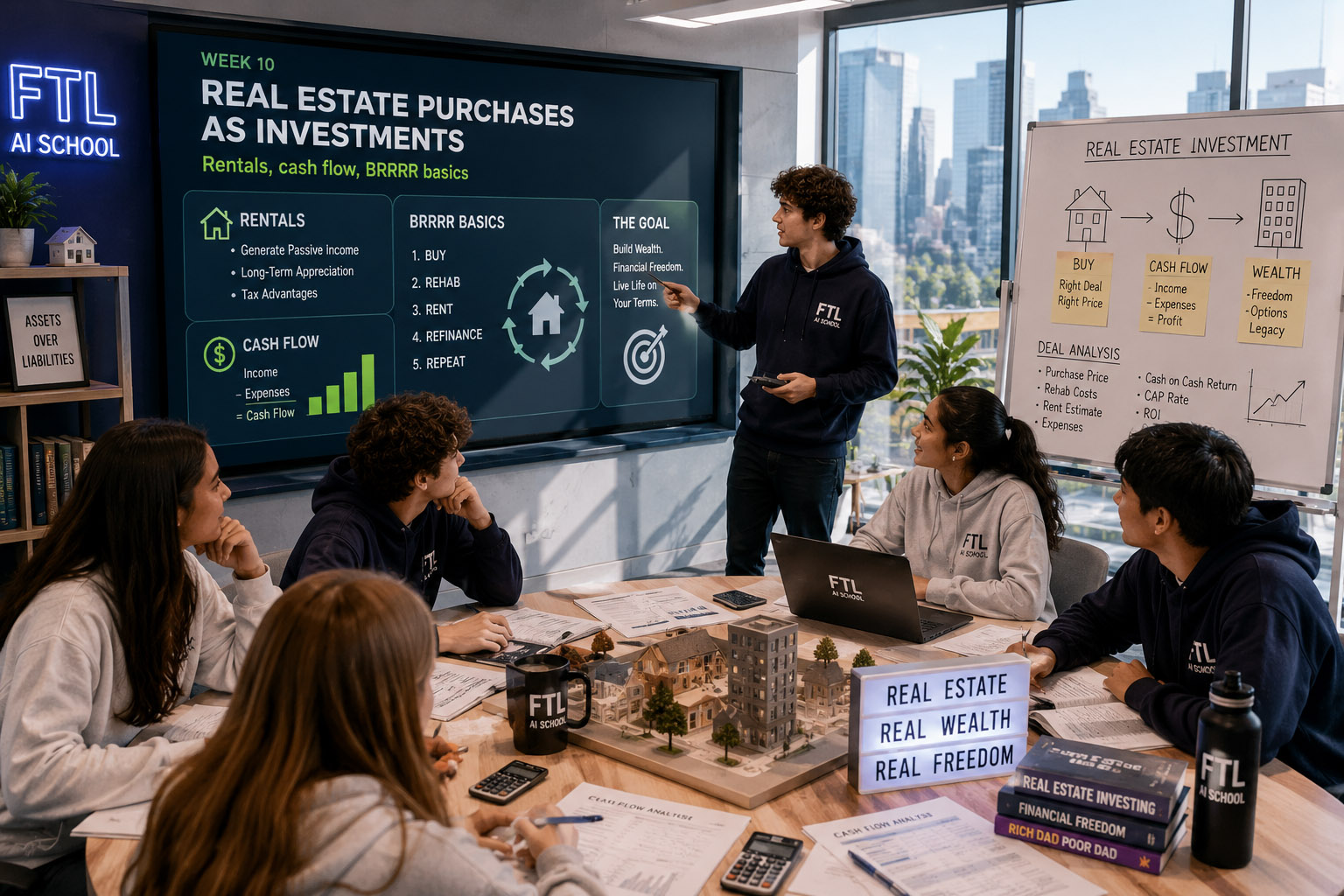
In this camp, students will learn what it means to buy a home as a primary residence. They will explore the step-by-step process of purchasing a house, including down payments, mortgages, credit, inspections, insurance, taxes, closing costs, and monthly payments.
Students will compare renting versus buying, learn how lenders evaluate borrowers, and understand how income, debt, interest rates, and property condition affect affordability.
What Students Will Learn
Area
Covered Topics
Home Buying Basics
Primary residence, buyer, seller, lender, title company, closing
Money Requirements
Down payment, closing costs, monthly payment, escrow
Mortgage Basics
Principal, interest, taxes, insurance, loan terms
Credit & Income
Credit scores, debt-to-income ratio, income verification
Property Review
Inspections, repairs, appraisal, insurance
Smart Decision-Making
Renting vs buying, affordability, location, long-term costs
Student Project
Students will review a sample home listing and determine whether a buyer could afford it based on income, down payment, loan terms, taxes, insurance, and monthly debt.
Week 10: Real Estate Purchases as Investments
Buying Your First Home: Real Estate as a Primary Residence
This is a repeat offering of the Week 2 real estate home-buying camp for families who need a later summer option.
In this camp, students will learn what it means to buy a home as a primary residence. They will explore the step-by-step process of purchasing a house, including down payments, mortgages, credit, inspections, insurance, taxes, closing costs, and monthly payments.
Students will compare renting versus buying, learn how lenders evaluate borrowers, and understand how income, debt, interest rates, and property condition affect affordability.
What Students Will Learn
Area
Covered Topics
Home Buying Basics
Primary residence, buyer, seller, lender, title company, closing
Money Requirements
Down payment, closing costs, monthly payment, escrow
Mortgage Basics
Principal, interest, taxes, insurance, loan terms
Credit & Income
Credit scores, debt-to-income ratio, income verification
Property Review
Inspections, repairs, appraisal, insurance
Smart Decision-Making
Renting vs buying, affordability, location, long-term costs
Student Project
Students will review a sample home listing and determine whether a buyer could afford it based on income, down payment, loan terms, taxes, insurance, and monthly debt.
This Summer Could Change Everything
This Summer Could Change Everything
Contact Us
337-366-8333
1211 N Cutting Ave, Jennings, LA 70546